How Long Does a Professional Website Redesign Actually Take?
The unsatisfying answer is: it depends.
The useful answer is understanding what it depends on.
A small website with ready-to-use content can move quickly. A bilingual professional-services site with twenty pages, new copy, custom functionality, stakeholder reviews, and integrations is a different project.
When website projects run late, coding is often not the main reason. The delays usually come from decisions, content, approvals, and scope changes.
A simple site and a complex site should not have the same timeline
Think in terms of complexity.
A simple redesign might have five to seven pages, an existing brand, content mostly ready, a basic form, and no major integrations.
A medium project might include multiple service pages, copy cleanup, case studies, custom design, local SEO structure, analytics, and a content area.
A larger redesign might include bilingual content, dozens of pages, e-commerce, payments, custom forms, CRM integrations, migrations, and multiple decision makers.
The timeline expands because the number of dependencies expands.
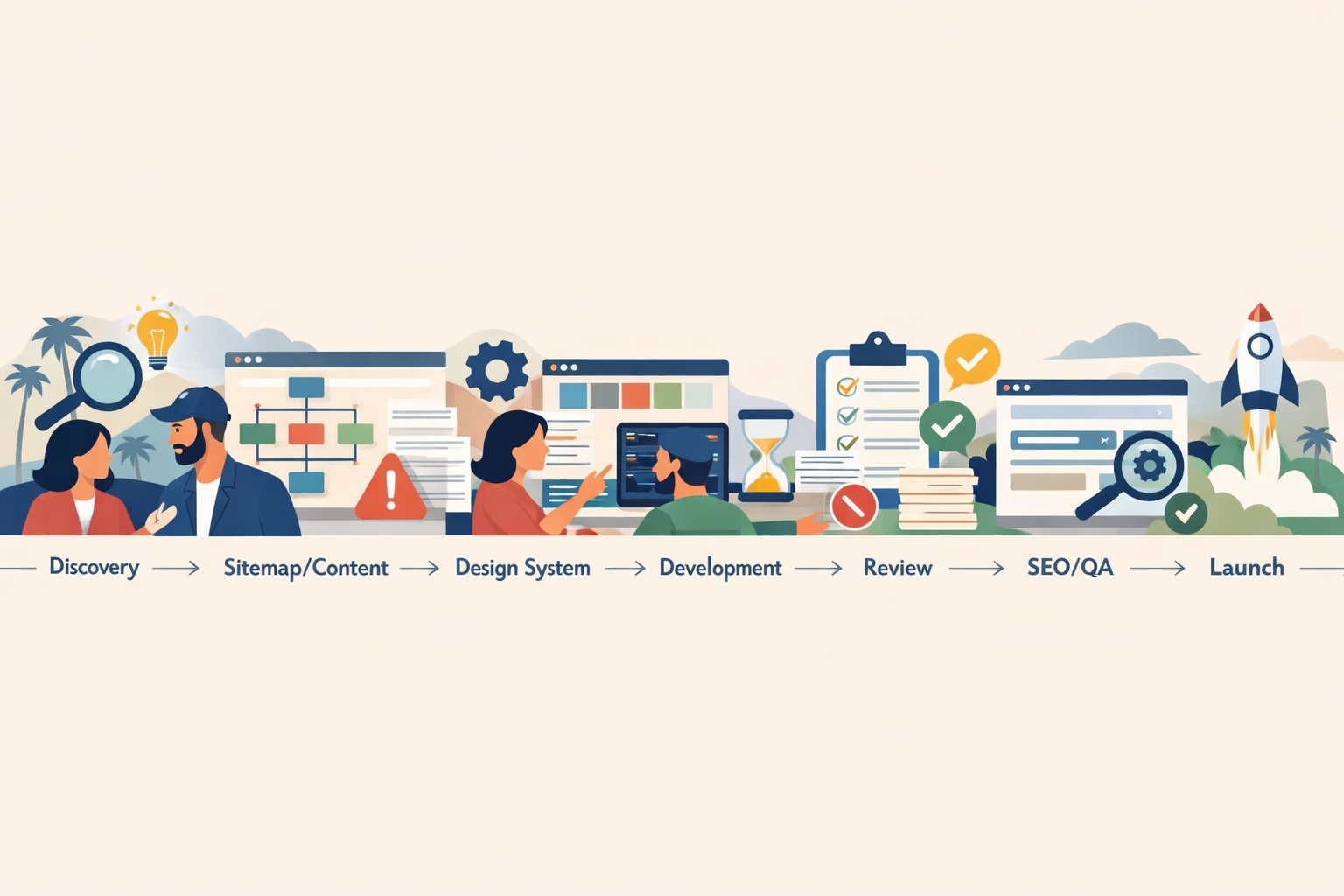
Phase 1: discovery
Before design, someone needs to understand the business.
Discovery can include business goals, target customers, primary services, service area, current website problems, competitor review, technical requirements, and future plans.
Skipping discovery feels faster. It often creates rework later.
A one-hour conversation that prevents the wrong site architecture is a good trade.
Phase 2: sitemap and content
This is where many projects slow down.
You need to decide which pages exist, what each page is supposed to accomplish, what content can be reused, what needs rewriting, and which photos and assets are available.
If nobody owns content, the developer eventually starts waiting.
A project moves much faster when one person at the client company is responsible for getting decisions and materials.
Phase 3: design direction
Not every project needs months of design work.
Often we need enough direction to establish typography, spacing, color, navigation, hero treatment, buttons, cards, forms, mobile behavior, and visual tone.
Once the system is approved, building the rest becomes much more consistent.
The slow version is redesigning every page independently.
Phase 4: development
Development may include responsive layouts, reusable components, forms, CMS, APIs, analytics, SEO metadata, structured data, integrations, and performance work.
A straightforward marketing site can move quickly here. Custom functionality can change the timeline substantially.
Phase 5: client review
Review should be structured.
The fastest review process is not “Everyone look at it and send me whatever you notice.”
I prefer review in rounds: first structure and major content, then visual details and corrections, then final QA for typos, links, forms, and mobile issues.
When feedback arrives from six people over two weeks in six different channels, development becomes project management.
Phase 6: SEO and migration
If the existing website already has traffic, migration deserves care.
Before launch, map important old URLs, preserve valuable content, create redirects where necessary, validate metadata, check internal links, generate a sitemap, confirm analytics, and review indexing controls.
Launching a redesign should not accidentally erase useful search history.
Phase 7: QA and launch
Before launch I want to test mobile, desktop, forms, email delivery, analytics, navigation, links, redirects, metadata, images, performance, error pages, and important integrations.
Then deploy.
A professional launch should feel boring. That means the problems were found before customers did.
What usually causes delays?
The most common causes are content that is not ready, nobody owning approvals, scope changes midway, missing third-party credentials, late photography, contradictory feedback, and a steady stream of “one more thing.”
None of these are unusual. They just need to be managed.
How to make your redesign move faster
If speed matters, choose one decision maker, collect logos/photos/brand files, list the pages you know you need, identify reusable content, get access to domain/hosting/analytics, define the must-have launch scope, move nice-to-haves into phase two, and set feedback deadlines.
The fastest website project is usually the one with the fewest unresolved decisions.
Should you launch everything at once?
Not always.
A phased launch can be smart:
- Phase 1: core website and lead generation
- Phase 2: blog or content engine
- Phase 3: payments or integrations
- Phase 4: custom customer features
This lets the business start getting value before every future idea is finished.
FAQ
How long should a simple business website take?
A focused site with ready content and fast approvals can move much faster than a large redesign. The actual schedule depends on scope and dependencies.
What delays website projects the most?
Content, approvals, changing scope, missing assets, and third-party access often cause more delay than coding itself.
Can a redesign be launched in phases?
Yes. Launching core pages first and adding secondary functionality later can be a practical way to hit a real business deadline.
The bottom line
Do not choose a developer because they promise an unrealistically short timeline. Choose a process that makes dependencies visible.
A professional redesign takes as long as the actual scope requires, but good preparation can remove a surprising amount of wasted time.