What Does an “SEO-Friendly Website” Actually Include Before Launch?
“SEO-friendly” is not a deliverable by itself
I see the phrase SEO-friendly website in proposals all the time. It sounds reassuring, but it can mean anything from “we installed an SEO plugin” to a genuinely thoughtful technical foundation.
For a small business, I would define an SEO-friendly launch much more concretely: search engines can access the important pages, the site architecture makes sense, each page has a clear purpose, old URLs are handled correctly, metadata is editable, analytics works, and the mobile experience is not fighting the user.
That is the baseline. It is not a promise that the site will rank first.
1. Important pages need to be crawlable and indexable
The first requirement is boring but essential: the pages you want discovered should be available in normal HTML, linked from the site, and not accidentally blocked by robots rules or noindex settings.
Staging environments often use noindex. That is good during development. It becomes a problem when the same setting ships to production.
Before launch I want a deliberate check of robots.txt, indexing directives, canonical tags, the XML sitemap, and whether the core pages can be reached through normal navigation.
2. Every important page needs a reason to exist
SEO architecture is not “make as many pages as possible.”
A page should represent a real service, product, location, question, or piece of expertise. If five pages are essentially the same paragraph with a different city name, the site is not becoming more useful.
I would rather build ten strong pages that map to actual customer intent than fifty thin variations.
The sitemap should reflect how the business sells, not how an SEO spreadsheet looks.
3. Titles, descriptions, headings, and URLs should be intentional
I want page titles that say what the page is actually about, headings that create a useful information hierarchy, and URLs that are understandable without decoding them.
Meta descriptions are not a magic ranking lever, but they are still useful page summaries and can influence how a result is presented.
The important point is that these elements should be controlled per page—not generated from one generic template that makes every page look the same.
4. Internal links should help people move through the site
Internal links are useful because they connect related information.
A contractor service page might link to a project gallery and financing FAQ. A law-firm practice page might link to an attorney profile and consultation page. A manufacturing product family might link to specifications and a wholesale inquiry.
That structure helps visitors and gives search systems clearer relationships between pages.
I do not like adding twenty keyword-heavy links to every footer. Good internal linking should feel natural.
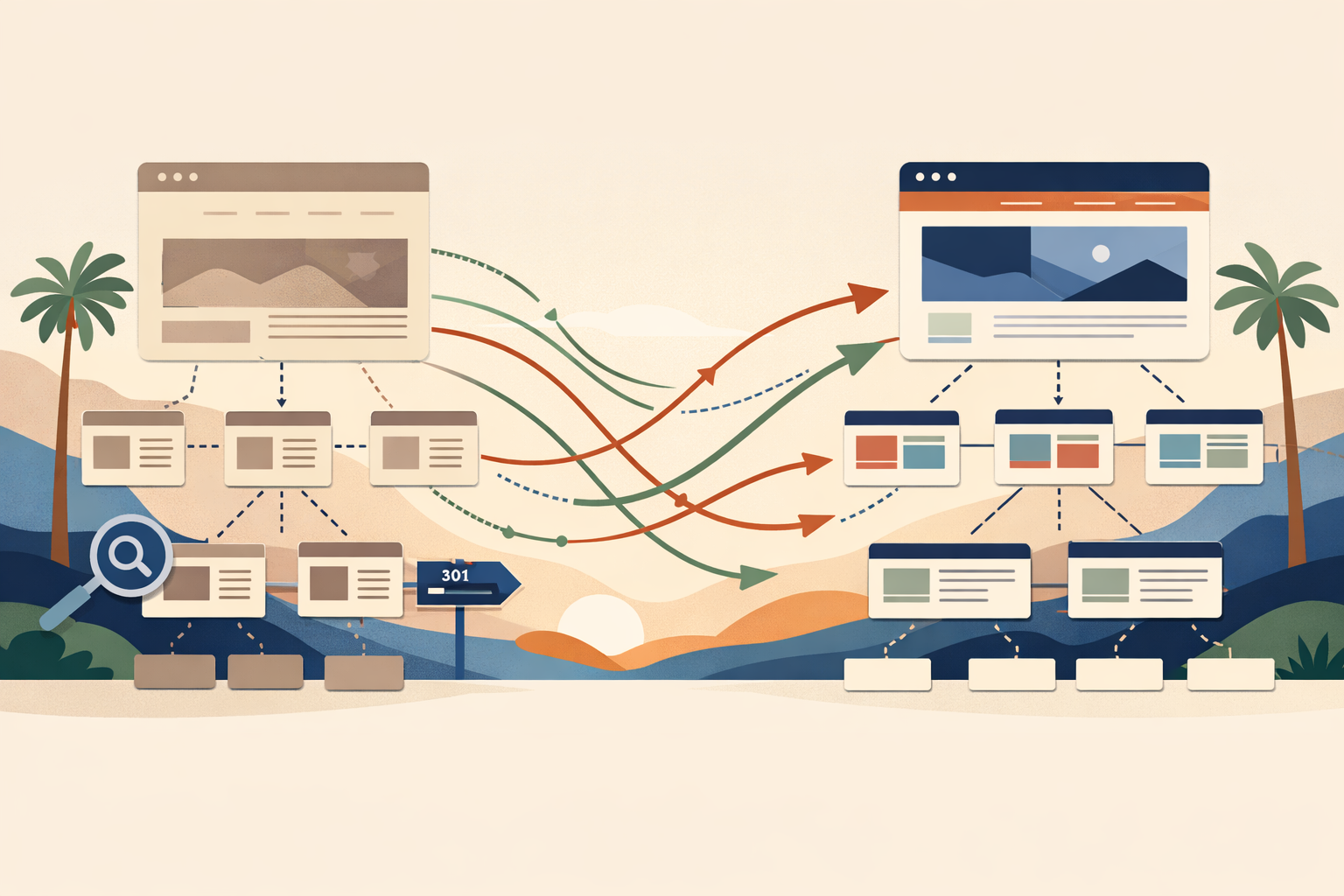
5. Existing traffic needs a migration plan
If the old website already gets search traffic, a redesign is also a migration project.
Before replacing URLs, I want to know which pages receive traffic, which have backlinks, which have been indexed for years, and which are safe to consolidate.
Then map old URLs to the best new destination with redirects where appropriate.
A visually better website can still be a business mistake if the launch quietly destroys the URLs that were already working.
6. Performance and mobile usability need to be reasonable
You do not need to chase a perfect laboratory score while ignoring the customer experience. But the site should load quickly enough, avoid huge unoptimized media, respond well on phones, and not shift around while someone is trying to click.
This is partly technical SEO and partly conversion work.
For many local businesses, the phone is the primary website experience. If the mobile site is frustrating, more search visibility will not fix the underlying problem.
7. Structured data should describe real content
Schema can be useful when it accurately describes visible information such as an organization, article, breadcrumb trail, product, or other supported content type.
I would not make structured data the centerpiece of an SEO pitch.
It is metadata about a good website. It does not compensate for weak pages.
Use it where it fits, validate it, and move on.
8. Analytics should be working on day one
I want to know more than page views.
At minimum, track the actions that matter to the business: form submissions, phone taps, booked calls, quote requests, checkout starts, purchases, or other real conversion events.
That makes the next SEO conversation much more useful because you can ask which pages bring qualified actions—not only which pages increased traffic.
What “SEO-friendly” does not include
A launch checklist does not replace ongoing SEO.
Ongoing work can involve new content, updating older content, local presence, reputation, digital PR or links, deeper technical work, conversion testing, and learning from search behavior.
The website build should give that work a clean foundation.
If a developer says “SEO is included,” ask them to list exactly what that means.
The bottom line
A professional website should not launch with preventable SEO problems.
I expect clear architecture, crawlable pages, intentional metadata, internal linking, sensible URLs, redirects, mobile usability, analytics, and a sitemap to be part of the foundation.
Then you can decide how aggressively to invest in ongoing search growth.
The goal is not to check an SEO box. It is to launch a business asset that can actually be discovered, measured, and improved.
FAQ
Does an SEO-friendly website guarantee rankings?
No. It removes preventable technical and structural problems, but rankings still depend on competition, relevance, authority, content quality, and ongoing work.
Should SEO be part of a website redesign?
Yes, at least at the foundation level: crawlability, redirects, metadata, internal links, sitemap, analytics, and preservation of useful existing pages.
Is installing an SEO plugin enough?
No. A plugin can help manage metadata and settings, but it does not create useful architecture, content, redirects, conversion tracking, or a search strategy.
Want help with this?
If you are rebuilding a business website and want the SEO foundation handled as part of the build, review my website development services or send me the current site.