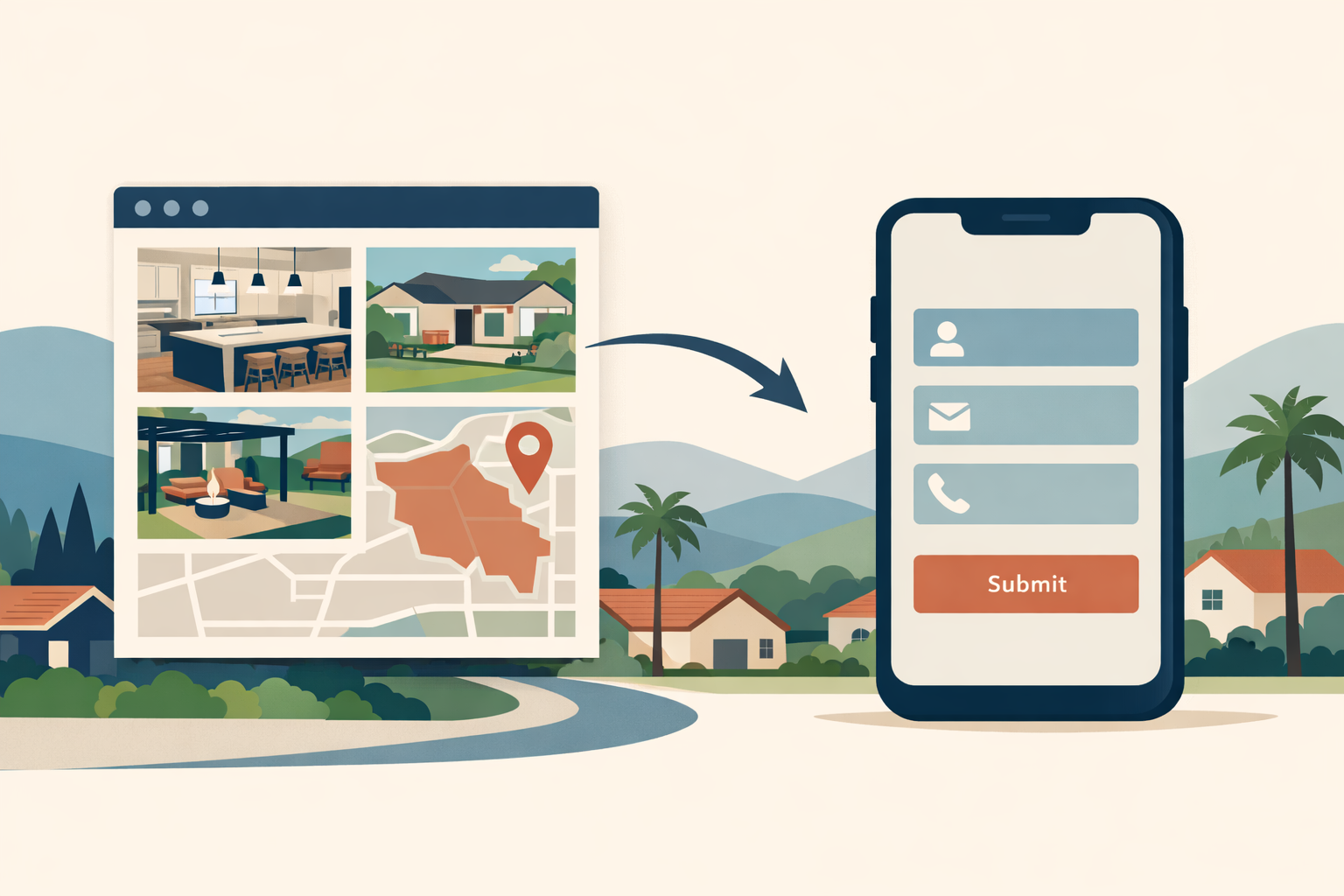
What a Contractor Website Needs to Turn More Visitors Into Estimate Requests
The website should make the estimate decision easier
A contractor website has a simple business job: make a homeowner comfortable enough to call, text, or request an estimate.
That sounds obvious, but many contractor sites are built like digital business cards. Logo. Three service bullets. A few stock photos. Contact form.
The homeowner usually needs more than that. They are deciding whether you do their type of work, serve their area, look legitimate, have done similar projects, and are worth inviting to their property.
Give major services their own useful pages
If you do roofing, concrete, remodeling, and ADUs, one generic Services page is usually too shallow.
A useful service page can show the kinds of projects you handle, common materials or options, what the process looks like, what affects pricing, common homeowner questions, real project examples, and the areas you serve.
That gives a referral something specific to send and gives search engines a clearer page to understand.
Use real project proof
For contractors, real work is one of the strongest forms of credibility.
I would rather see ten well-organized project examples than fifty generic stock photos.
Show before and after when it matters. Include the type of project, city or general area when appropriate, materials, constraints, and a short explanation of what was done.
You do not need a massive case study for every job. Give the visitor enough context to recognize work like theirs.
Make service area clear without creating spammy city pages
Home-service businesses often cover several cities.
Be specific about the areas you actually serve. You can include meaningful location pages when the business has enough unique local context, projects, or operational information to make them useful.
What I would avoid is cloning the same page thirty times and swapping Riverside for Corona, Moreno Valley, or Redlands.
Local relevance should reflect a real service footprint.
Put trust signals near the decision
Do not hide all credibility on an About page.
Near the estimate CTA, show the evidence that reduces risk: licensing information where relevant, insurance language if appropriate, review excerpts, years of experience, warranties or guarantees you actually offer, financing information, associations, and real team or project imagery.
The exact proof depends on the trade. The principle is the same: answer the question, “Can I trust these people at my house?”
Make mobile calling effortless
A homeowner may be comparing three contractors from a phone.
The number should be tappable. Buttons should be large enough. The service menu should not require precision. The gallery should load quickly. Forms should not have twenty fields.
For urgent trades, a clear Call Now path may matter more than a long intake form.
For larger projects, a structured estimate form may qualify the lead better.
Build the estimate form around how sales actually works
Ask the sales team what information they need before responding.
Useful fields might include project type, city, property type, approximate timeline, photos, and a short description.
Do not ask for information nobody uses.
If photo upload helps you quickly distinguish a real project from a bad fit, that feature can save more time than another decorative homepage animation.
Explain what happens after the form
Uncertainty creates drop-off.
Tell the visitor whether you call back, text, schedule an onsite visit, request photos, or provide a preliminary conversation first.
If the typical process is “Submit details → we call within one business day → onsite estimate → proposal,” say that.
A small process section can make the business feel dramatically more organized.
Connect leads to the system you actually use
A website lead should not become an email that gets lost.
If your business uses a CRM, scheduling tool, estimating platform, or shared inbox, the form can often send structured information there.
Even a simple workflow—confirmation email to the homeowner, lead notification to the right person, source tracking, and a saved record—can reduce follow-up mistakes.
The bottom line
A contractor website does not need to be flashy.
It needs to prove you do the work, make services easy to understand, show where you operate, reduce trust concerns, and make requesting an estimate simple on a phone.
Build the website around the real sales process and the pages become much easier to prioritize.
FAQ
What pages should a contractor website have?
At minimum: a clear homepage, major service pages, project proof, service-area information, about/trust information, and an estimate or contact path.
Should contractors use online estimate forms?
Usually yes when the form asks only for useful qualification details. For urgent services, a prominent phone path may still be more important.
Do contractors need city pages?
Only when a location page can provide real local value. Avoid cloning the same page for every city with only the place name changed.
Want help with this?
If your contracting business already gets referrals but the website does not convert them well, I can help rebuild the site around estimate requests and project proof.